Illustration: During an activity in a Japanese language classroom, an instructor places two daikon radishes upright on a low demonstration table. One is impressively long and the other almost comically short, with their leafy tops at very different heights.

JLPT N3nounLevel estimated by Bebop

形けい容よう詞し

keiyoushi

adjective

In Japanese grammar, this usually refers to an i-adjective. Note written by AI.

Example sentences

  1. 名詞めいしを修飾しゅうしょくするものは、形容詞けいようしまたは形容詞相当語句けいようしそうとうごくです。

    Things that modify nouns are adjectives or equivalent to adjectives.

    Tatoeba · CC BY 2.0 FR · Source

  2. 英語えいごの副詞ふくしの中なかには形容詞けいようしの役目やくめをするものがある。

    Some English adverbs function as adjectives.

    Tatoeba · CC BY 2.0 FR · Source

  3. 英語えいごには8つの主おもな品詞ひんしがあります: 名詞めいし、動詞どうし、形容詞けいようし、副詞ふくし、代名詞だいめいし、前置詞ぜんちし、接続詞せつぞくしそして感嘆詞かんたんし。

    In English there are eight main parts of speech: noun, verb, adjective, adverb, pronoun, preposition, conjunction and finally interjection.

    Tatoeba · CC BY 2.0 FR · Source

Kanji in 形容詞

  • 形shape; formOnケイ・ギョウKunかた・かたち・なり
  • 容contain; formOnヨウKunいれる
  • 詞part of speech; wordsOnシKunことば

A word like this on every new tab

The Bebop Chrome extension shows one illustrated Japanese word each time you open a new tab in Chrome, with its reading, meaning, kanji and three example sentences. Choose any mix of levels from N5 to beyond N1. It’s free, with no account.

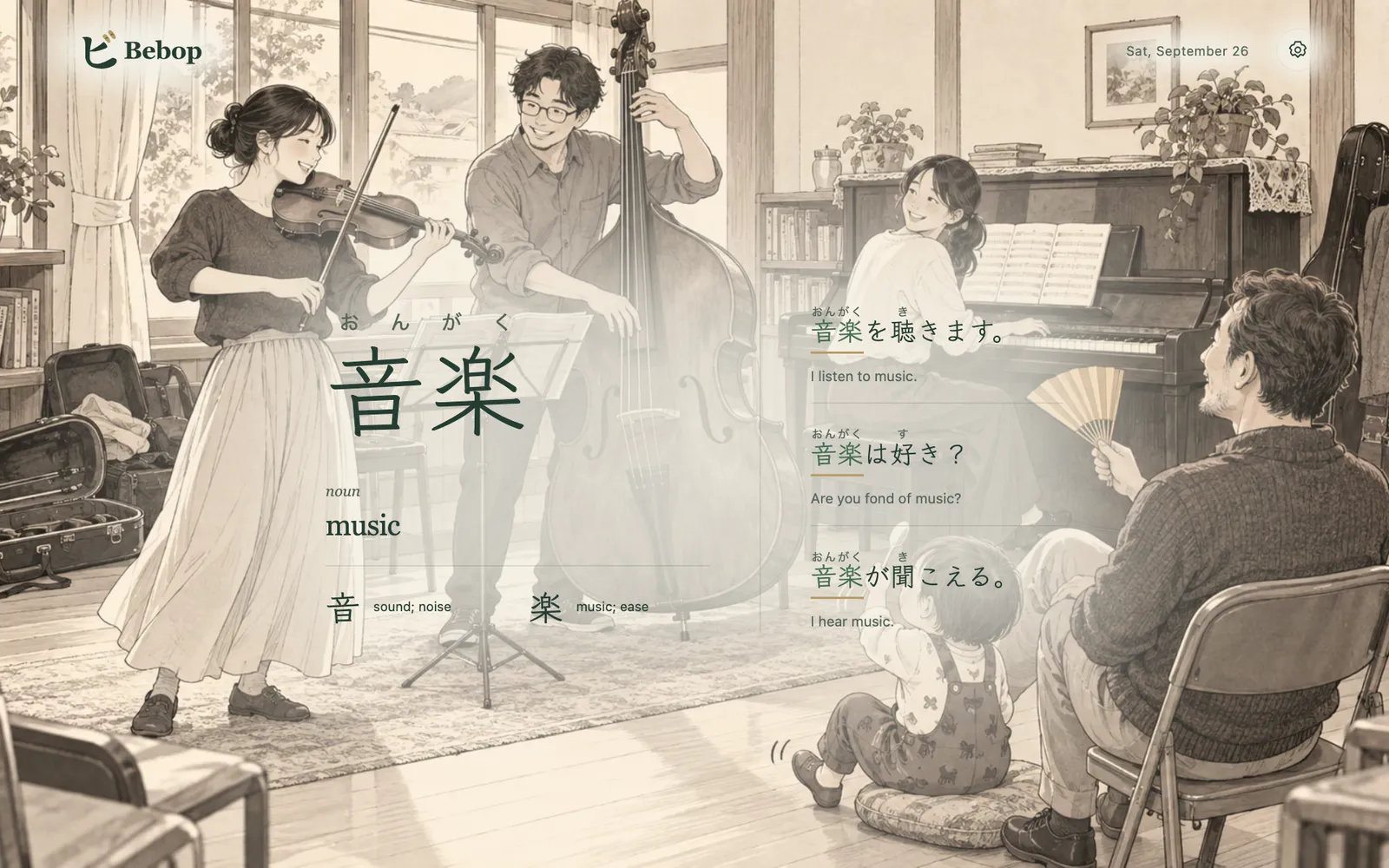
The Bebop new tab showing 音楽, music, over an illustration of a family playing music at home, with three example sentences
Add to Chrome Free on the Chrome Web Store
For Chrome on a computer. See it on the Chrome Web Store